Plaster and drywall · Cambria County
Drywall and Plaster Repair in Johnstown, PA
Cracked plaster, ceiling stains, holes and tired corners, repaired and blended into the wall around them so the spot is ready for paint. Start by phoning or sending a picture.
On that first call, a local pro hears what happened and gets your quote moving.
Call 7 days, 7am–9pm
Ceiling faults
Ceilings take the hardest hits in an older house. Water finds them first, and gravity works on every loose piece of plaster. The good news: most ceiling problems are manageable once you know which kind you have. Here is a short field guide.
Rings and stains
Brown tide lines on a ceiling tell you water got there at some point. The leak has to be found and stopped first. Then the board or plaster behind the ring is checked for moisture, and the stain is sealed with a blocking primer before any paint. Next step: note when the ring showed up and what sits above it.
Bulges and sags
If the ceiling is holding water or hanging lower than it should, go to the breaker box first and shut off whichever breaker powers the lights or fan set into that stretch of ceiling. Next, clear the room below so nobody stands beneath the bulge, and set a pail under the low point. Then call. A sag in old plaster can also mean the plaster has let go of its lath, which is worth handling soon.
Taped seam lines
Straight lines across a drywall ceiling are usually taped joints showing through. Tape can lift when it was set in too little compound, or when the framing moves. A proper fix cuts away the loose tape, beds new tape and feathers the joint wide so the line fades.
Popcorn finish
A damaged patch of popcorn texture can be cut back and re-sprayed so it reads close to the rest. If the ceiling went up before the 1980s, the texture is worth an asbestos test before any scraping starts. You can ask the pro about that on the first call.
Truss uplift gaps
In newer houses built with roof trusses, a crack can open where the ceiling joins an inside partition each winter and close again in summer. That is the truss bowing, not the wall failing. Flexible corner tape or trim makes it easy to live with.
Primer and sheen
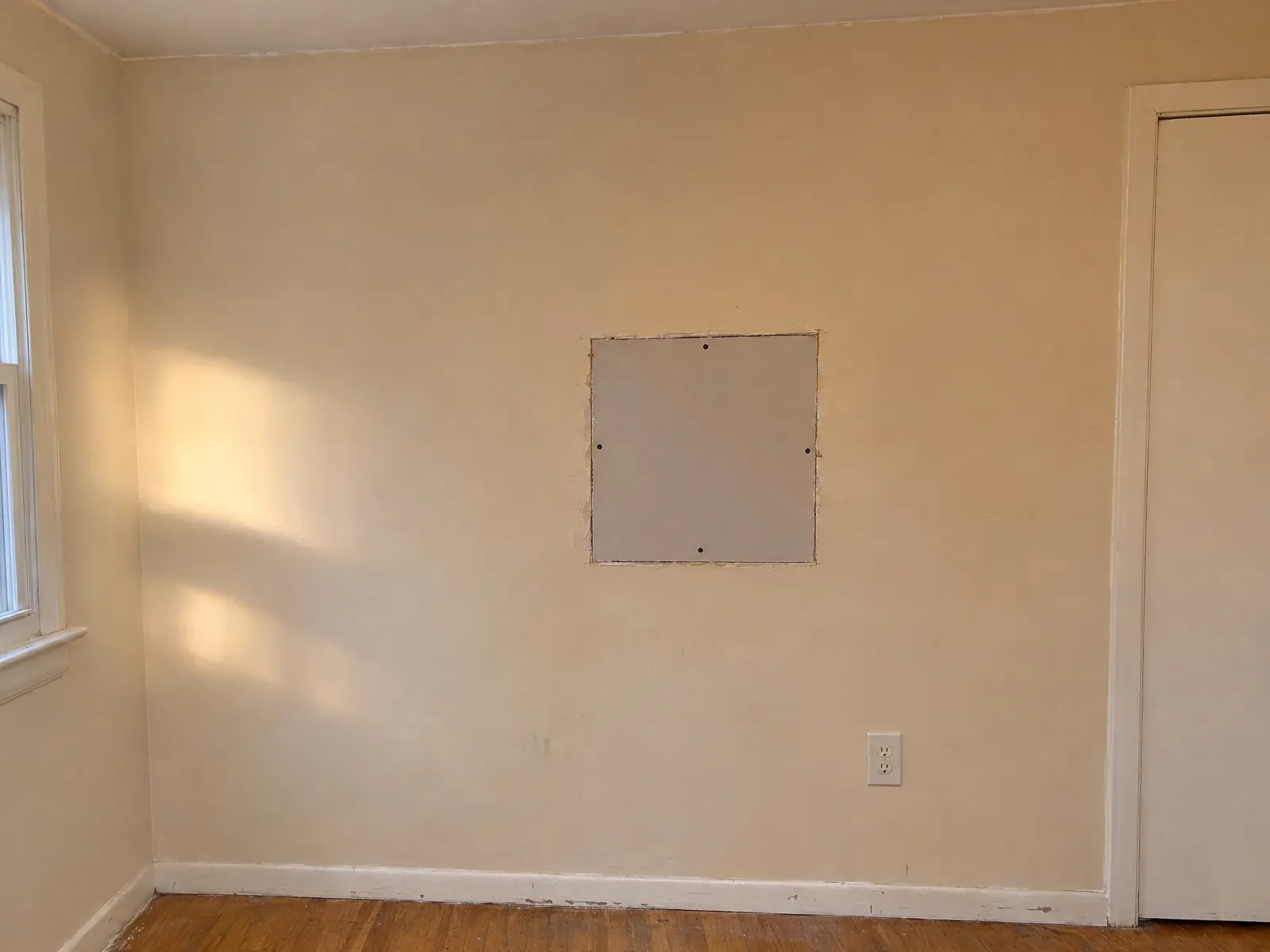
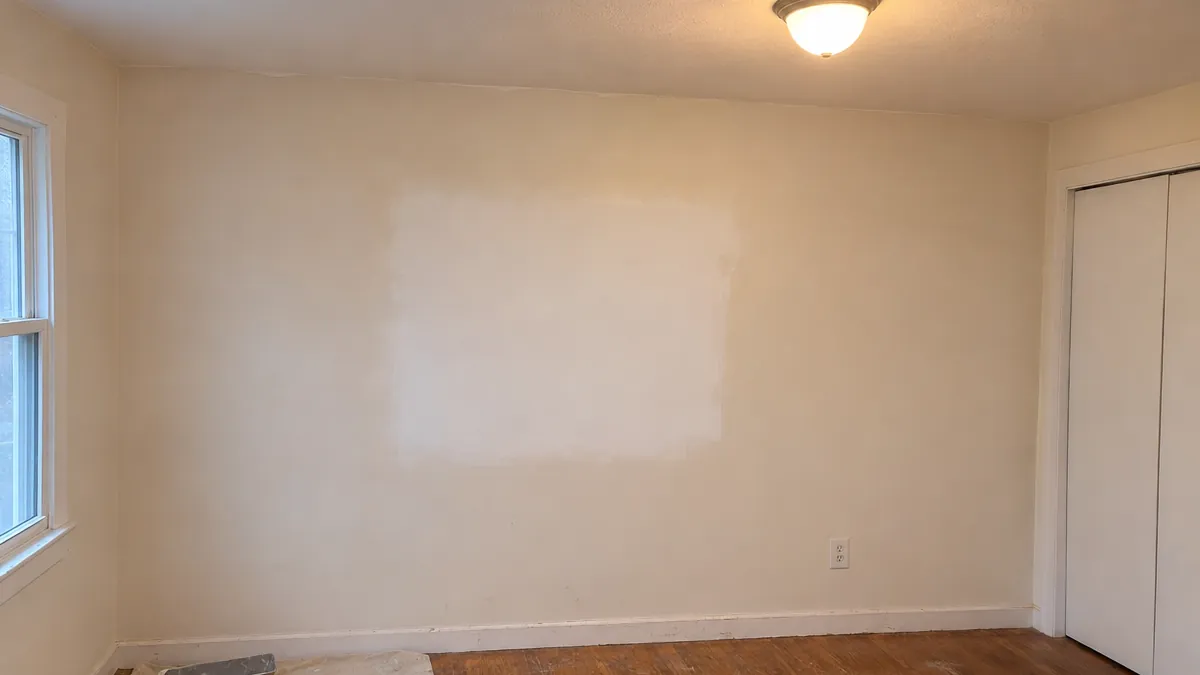
A repair is only half done until the paint goes on. The patch can be flat and smooth and still show up as a dull square under fresh paint. Painters call that shine difference flashing. It is easy to head off with the right steps.
Patch flashing
Joint compound soaks up paint faster than the old wall around it. Without a primer coat, the patch dries flatter and catches the light. A coat of drywall primer over the repaired area evens that out. Next, the finish color is rolled well past the patch edges, ideally out to the nearest corner.
Surface grain
Old plaster walls are rarely glass smooth. They carry a slight sand finish or the trowel marks of whoever plastered them. A smooth drywall patch in the middle of that looks wrong. A light texture worked into the last coat helps the patch sit in with the wall around it. The repair guides section goes further into primers and compounds.
Final paint coat
Some people paint the repair themselves; others want the area finished in color. Either way works. Say which way you want it on the phone, and have the paint can or color name handy if you still have it. Sheen matters as much as color: eggshell over a flat wall will show.
The four repairs
Four kinds of repair cover almost everything an old or newer wall in the valley can throw at you. Choose whichever sounds most like your wall and start there. If it is a mix, that is fine too; one quote can cover several spots.
Plaster repair
Cracked, bulging or loose plaster reattached, patched or replaced with drywall where it has failed.
Plaster repair for older Johnstown, PA housesWater-damaged drywall
Stained, soft or sagging ceilings and damp basement walls dried, cut back and rebuilt.
Water-damaged ceilings and basement wallsCrack repair
Wall and ceiling cracks from settling and seasonal movement opened, taped and blended.
Wall and ceiling crack repairHole patching
Doorknob holes, dents, anchor holes and broken corners patched and textured to match.
Drywall patching for holes and dentsPrice depends on size, height, how many spots there are, whether the wall is plaster or drywall, and whether whether the quote includes texture or paint. For a rough idea, Fixr's countrywide price guide for drywall work (January 2025 edition) lists most drywall repairs between $200 and $550, with holes at about $60 to $200 and water-damage repair for a single room at about $400 to $800. These numbers are averages for the whole US, not this valley. The real number for your wall is set by the local pro after a conversation about it.
Urgent versus deferrable
Not every crack needs a call this week. Some damage gets worse if it waits; some can sit until a weekend that suits you. Here is a simple way to sort it.
Higher priority
- A ceiling that is wet, soft or bulging. Water adds weight, and wet board or plaster can let go. Power off to nearby fixtures, then call.
- Plaster that gives under your palm. Its grip on the lath has failed. Overhead, a loose piece can drop.
- A crack that keeps getting wider, or one that showed up along with a sticking door. That points to movement worth having looked at by the right trade.
- A hole with wiring or pipe showing. Close it up so nothing gets snagged or damaged.
Lower priority
- Hairline cracks that have not changed in months. These are cosmetic. Bundle them with other work.
- Nail or screw pops. Annoying, but they are not going anywhere.
- An old, dry stain from a leak that was fixed. It can wait for a paint project, as long as the area is dry.
- Dings, dents and chipped corners. Easy to save up and handle in one visit.
Not sure which list your wall belongs on? Send a photo and describe what changed. You will get a straight answer about timing.
Valley towns served
The work covers the city and the boroughs and townships around it, from the hilltops down to the river flats.
- Westmont. The hilltop borough the Cambria Iron Company laid out as a suburb for its top personnel.
- Southmont. Up on the heights above the Stonycreek valley, incorporated in 1919.
- Ferndale and Geistown. Two boroughs south and southeast of the city, incorporated in 1896 and 1930.
- Richland Township. The central retail area for the region, with a University of Pittsburgh campus.
- Windber. The former coal company town across the line in Somerset County.
- Conemaugh Township. Bordering the city on its east side.
Each town gets a few lines on the full service area page.
Electrical and plumbing holes
Electricians, plumbers and HVAC installers often have to open a wall to do their part. They close the circuit or the pipe, not the hole. That gap is where a drywall repair comes in, and it is one of the more manageable jobs on this list.
Square cut-outs
First the ragged edge becomes a neat rectangle. Strips of wood fastened inside the cavity give the insert solid footing. Then the insert goes in, gets taped, and is coated in thin layers.
Plaster openings
In a plaster wall, the opening is built back up to the thickness of the old plaster, often with drywall and shims, so the patch lands level with the old plaster face instead of recessed.
Timing
Schedule the patch for after the other trade has signed off and any inspection is done. If an inspector still needs to see inside the wall, the hole has to stay open until then. Your next step is a quick check with that trade.
Older districts
The city's population peaked at 67,327 in the 1920 census, and its historic districts are full of buildings from the decades around that peak. Here are a few districts and what their age means for a repair.
Cambria City
A National Register historic district listed in 1991. The majority of its buildings went up between 1890 and 1920, many of them two-story balloon-frame houses, detached and semi-detached. Balloon framing runs studs in long open bays, so an opening in the wall may need new blocking behind it before a patch can go in.
Moxham
Listed on the National Register in 1999; the majority of its buildings date to the 1890–1930 span. The houses include American Foursquares, bungalows and Colonial Revival homes. Foursquare plans have large, square rooms, and a long crack across one of those ceilings is very fixable.
Westmont hilltop
The Cambria Iron Company laid out the hilltop as a suburb for its top personnel, and it was incorporated as a borough in 1892. The Inclined Plane up Yoder Hill began running in 1891. Houses from that era were usually plastered, so plaster-specific repairs are likely here.
Downtown blocks
The downtown historic district, listed in 1992, takes in the business district and the homes around it. The majority of its buildings come from 1890 to 1930. In brick buildings of that age, plaster is often applied straight to the masonry, which calls for plaster-friendly patching materials.
Garage and basement walls
Lower-level walls have their own rules. On hilly lots, water tends to run toward foundations, and a basement can stay damp for a while after a wet spell. Garages see bumpers, bikes and shelving. Both are fine to repair once a few basics are covered.
Damp basement drywall
Wait until the wall is dry and the source of the water is handled. Board that got wet from the bottom usually gets cut off above the wet line, then replaced. Mold-resistant board and a gap above the floor make sense down here. Start by checking whether the wall feels cool and damp near the floor.
House-to-garage wall
The wall and ceiling dividing living space from an attached garage are often finished in Type X board, the fire-resistant kind. A hole there should be patched with the same type of board and fully taped, not left open or covered with a scrap. Ask for Type X by name when you call.
Bumper and handlebar dents
Car doors and handlebars make dents and holes at the same height over and over. A patch with a corner guard or a strip of plywood behind it can help the wall hold up better next time.
Quote request
Three steps, and the first one takes a couple of minutes. There is more on how the business works if you want the background.
- Send it. Phone, or send a picture with a rough size and the room. A ruler or a dollar bill in the shot helps.
- Get a quote. A local pro talks the damage through with you and names a figure. Work waits for your go-ahead.
- Repair and finish. The spot is patched, sanded and textured to sit in with the wall, then primed so your paint can go on.
Calling puts you on the line with someone who can arrange a local pro to price the job.
Call 7 days, 7am–9pm
What follows: a drywall pro based near you rings back, hears about the damage and works out a quote.